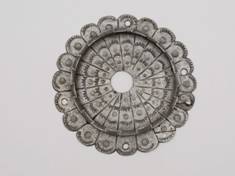
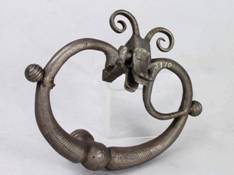
Door knocker with backplate
Central Europe, first half of 16th century
Malleable iron. A round bar with a wrought cone in the centre serves as the hammer. The mount holding the upper part of the ring is formed by an ibex head with curled horns. A flange castellated along the perimeter is forged to the rosette backplate. Decorated with scalloped reeding and circular punch marks.
H: 12 cm / Diameter: 10 cm
UMP 3170
Door knockers were available in a diverse variety of shapes. Square and round iron bars could be cold-formed or forged at blacksmiths’ workshops. Bars forged into heart or oval shapes were often hammered out at the centre, which might have been decorated with pierced trefoils or quatrefoils or with repoussage and an openwork band. In the Late Gothic period, plaited branches, snakes, or lizards were used as forms for ring-shaped door knockers. Ring mounts and hammers were often decorated with forged animal heads, usually stags or ibexes with curled horns, but sometimes also wild man masks.